
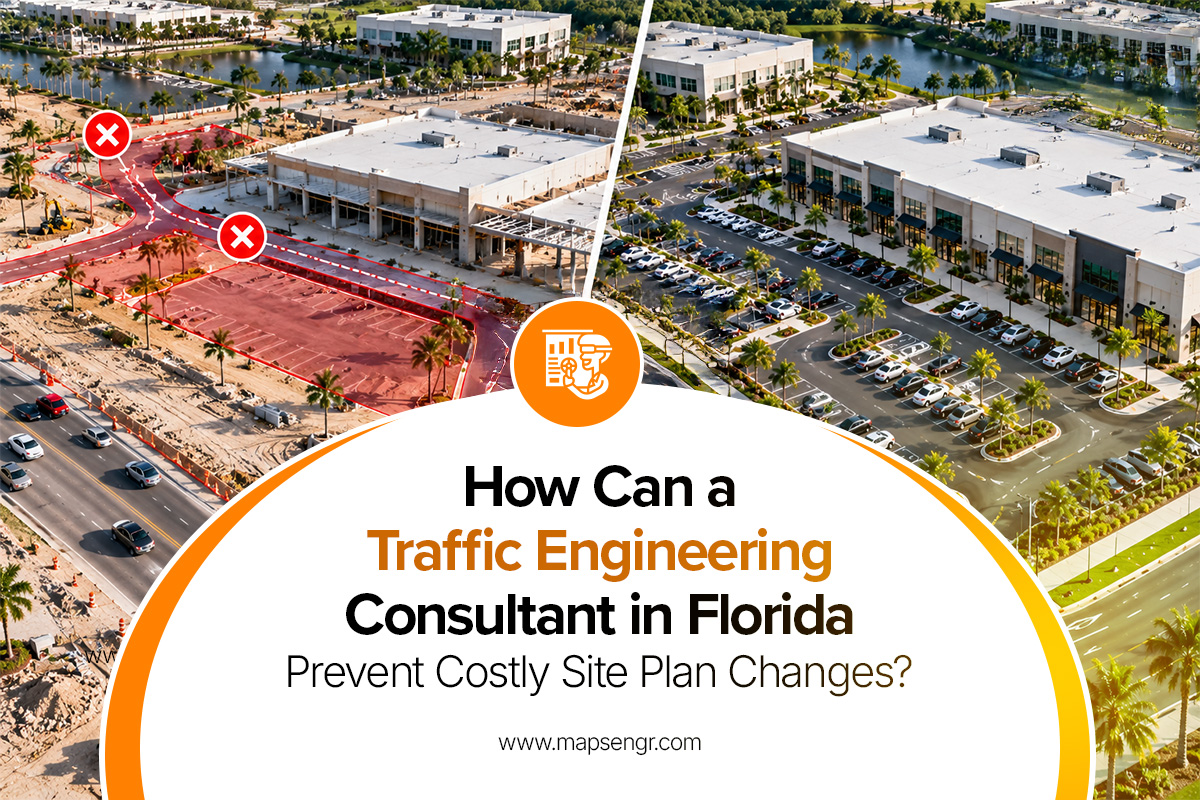
A site plan may look complete until transportation review introduces issues related to access, parking, and circulation. At that point, even small revisions can affect drainage, utilities, landscaping, and building placement. The key challenge for development teams is not whether transportation issues exist, but when they are identified. A traffic engineering consultant in Florida helps uncover these issues early, when changes are still manageable.
Why Transportation Issues Disrupt Site Plans
Transportation design is interconnected. A single driveway location can influence queueing, parking layout, pedestrian safety, and frontage improvements. Review agencies evaluate how vehicles enter and exit a site, how traffic interacts with nearby intersections, and whether internal circulation is safe and efficient.
When these concerns arise late, multiple design elements may need revision at once. For example, a required turn lane can impact right-of-way, utilities, and landscaping. Similarly, insufficient queue storage can block parking aisles or extend into public roads. These are not minor edits—they are coordinated design changes with cost and schedule impacts.
How Early Traffic Engineering Prevents Redesign
Early involvement of traffic engineering services in Florida allows teams to test assumptions before the site plan is finalized. At MAPS, we work with developers and design professionals to evaluate access, circulation, and parking while alternatives are still available.
This early review typically examines peak-hour operations, queue lengths, and nearby intersection capacity. By identifying potential constraints early, the design team can adjust layouts proactively instead of reacting to agency comments later in the process.
Key Questions to Address Early
Several transportation questions often determine whether a site plan remains stable or requires revision:
- Are driveway locations safe and properly spaced?
- Can vehicle queues be stored within the site?
- Will turn lanes or roadway improvements be required?
- Does parking reflect actual demand, not just minimum code?
- Are pedestrian and delivery routes coordinated with vehicle flow?
- How will future development phases affect access?
Addressing these questions early helps teams compare design options before constraints become fixed.
How Access and Queueing Shape the Design
Access design is often the first transportation element reviewed, but it affects the entire site. If queues exceed available storage, vehicles may spill into parking areas or public roads, creating safety and operational issues.
Queue analysis estimates how many vehicles will wait at entrances during peak conditions. If storage is insufficient, adjustments may be needed to driveway placement, internal circulation, or site operations. Identifying this early prevents major redesign later in the process.
Why Turn Lanes and Intersections Matter
Turn lane requirements can significantly affect site layout. Agencies may require additional space based on traffic volumes or roadway conditions. This can impact building placement, utilities, stormwater design, and landscaping.
Intersection impacts may also require changes to signal timing or access configuration. These adjustments are far easier to implement during early design stages when the layout is still flexible.
Can Parking Decisions Trigger Redesign?
Parking is often treated as fixed, but demand varies by use, timing, and user behavior. A layout that meets code may still create circulation issues if demand is underestimated or poorly distributed.
MAPS evaluates parking alongside traffic and access to ensure the system works as a whole. In some cases, space can be used more efficiently. In others, adjustments are needed to avoid conflicts. The goal is not simply compliance, but functionality.
How MAPS Integrates Traffic, Parking, and Mobility
A common issue in development is treating traffic, parking, and mobility separately. This can lead to conflicting assumptions and late-stage revisions. As a traffic engineering consultant in Florida, MAPS evaluates these elements as a unified system.
We analyze how vehicles, pedestrians, deliveries, and parking interact across the site. This includes access points, internal circulation, and curb activity. By coordinating these factors early, teams gain a clearer understanding of how the site will function during review and operation.
When to Involve a Traffic Consultant
The best time to engage a traffic consultant is during conceptual planning, before access points and layouts are finalized. At this stage, even small adjustments can be made without major disruption.
As design progresses, changes become more complex and costly. Early analysis helps identify risks before they affect multiple disciplines and require redesign.
Conclusion
Transportation planning is most effective when addressed early in site design. Identifying access, queueing, parking, and circulation issues before finalizing the layout helps prevent costly revisions. With support from traffic engineering services in Florida, development teams can make informed decisions and reduce uncertainty.
Working with a traffic engineering consultant in Florida like MAPS ensures transportation considerations are integrated from the start—before they become constraints that reshape the entire project.