
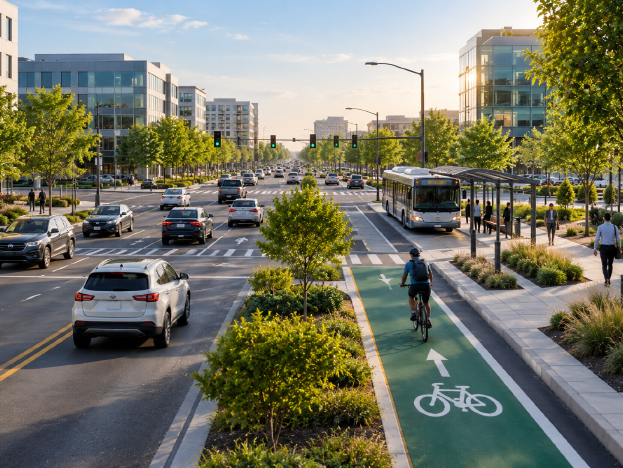
Hospitals are complex environments where patients, visitors, and staff all rely on smooth, efficient movement to ensure safety and timely care. Parking, often overlooked, is a critical factor in this system. When parking facilities are poorly planned, it can delay access to care, add stress to patients, and disrupt staff operations. That is why we emphasize the need for a Hospital Parking Planning Consultant to design strategies that make hospital campuses easier to navigate for everyone.
Why Parking Access Impacts Patient Care
For hospitals, accessibility goes far beyond clinical services. A well-organized parking system can significantly reduce bottlenecks and confusion at entry points. Patients arriving for treatment often experience high stress levels, and complex or inadequate parking layouts only add to that burden. Similarly, visitors seeking their loved ones require straightforward access, while staff need reliable parking options to support shift changes and emergency responses.
When parking infrastructure is not carefully considered, the result is congestion, lost time, and a negative patient experience. A consultant’s role is to evaluate how every element of parking connects with patient flow, safety, and campus functionality.
How a Hospital Parking Planning Consultant Creates Value
A consultant specializing in hospital parking brings technical knowledge and an integrated perspective to the table. Their work includes assessing existing parking conditions, projecting future demands, and planning expansions or redesigns. By analyzing traffic flow patterns, pedestrian movement, and peak usage times, consultants identify solutions that align with both hospital operations and community expectations.
Key benefits include:
- Operational Efficiency: Improved traffic circulation reduces delays at entrances, emergency zones, and drop-off areas.
- Patient Satisfaction: Accessible parking lessens anxiety for patients and families already facing medical concerns.
- Staff Productivity: Reserved and well-planned staff parking ensures smoother shift transitions.
- Safety: Design considerations help minimize pedestrian-vehicle conflicts and improve emergency vehicle access.
Planning That Adapts to Future Demands
Hospitals are dynamic facilities, often expanding to serve growing communities. A Hospital Parking Planning Consultant develops strategies that account for both present needs and future growth. This may involve phased construction planning, reconfiguring lots to maximize capacity, or integrating sustainable elements like EV charging stations.
- Forecasting Needs: Consultants use data modeling to anticipate increases in patient visits, staff requirements, and community growth.
- Designing for Flexibility: Parking systems are planned to accommodate future expansions without disrupting hospital operations.
This forward-looking approach ensures that hospitals are not just solving today’s access challenges but are prepared for tomorrow’s demands.
The Role of the Downtown Parking Study in Hospital Planning
Urban hospitals face an additional challenge: competing with city traffic. A Downtown Parking Study provides insights into how hospital traffic interacts with nearby businesses, public transit, and municipal parking systems. This holistic evaluation ensures hospitals remain accessible even in high-density areas where parking demand is already intense.
By integrating hospital planning with downtown studies, consultants can recommend solutions that balance the needs of both the medical facility and the surrounding community. This might include shared parking strategies, improved wayfinding systems, or partnerships with municipal authorities.
Sustainable and Inclusive Parking Solutions
Modern hospital planning increasingly emphasizes sustainability. Parking consultants can help hospitals incorporate eco-friendly strategies, from stormwater management to energy-efficient lighting and EV infrastructure. Inclusivity is another vital factor, ensuring ADA-compliant spaces and accessible routes that make every patient and visitor feel accommodated.
These efforts not only improve patient access but also align hospitals with broader community goals of environmental stewardship and accessibility.
Why Specialized Expertise Matters
Hospitals cannot afford to treat parking as an afterthought because it directly affects patient outcomes, visitor experiences, and staff efficiency. Parking facilities are often the first and last point of contact for anyone entering or leaving a hospital, which means the design and functionality of these spaces influence perceptions of care quality and accessibility. A consultant’s specialized expertise ensures that every square foot of parking space contributes to a safer, more efficient, and more welcoming environment.
Beyond layout and capacity, consultants evaluate circulation routes, pedestrian safety, and emergency vehicle access to eliminate bottlenecks and reduce risks. They also consider integration with broader transportation systems such as public transit, rideshare, and drop-off zones to make patient arrival smoother. By aligning parking and transportation systems with patient care priorities, consultants create a seamless connection between arrival and treatment, helping hospitals function as truly accessible healthcare campuses.
Conclusion
Hospital campuses function best when access is carefully planned, and parking is a key part of that system. A Hospital Parking Planning Consultant ensures parking facilities are designed with precision, foresight, and inclusivity, while tools like a Downtown Parking Study provide added insights for urban hospitals. At MAPS Engineering, we focus on creating sustainable and efficient solutions that improve access for patients, staff, and visitors alike.
Visit us today to explore how tailored parking planning solutions can transform hospital access, enhance safety, and improve overall patient experience.